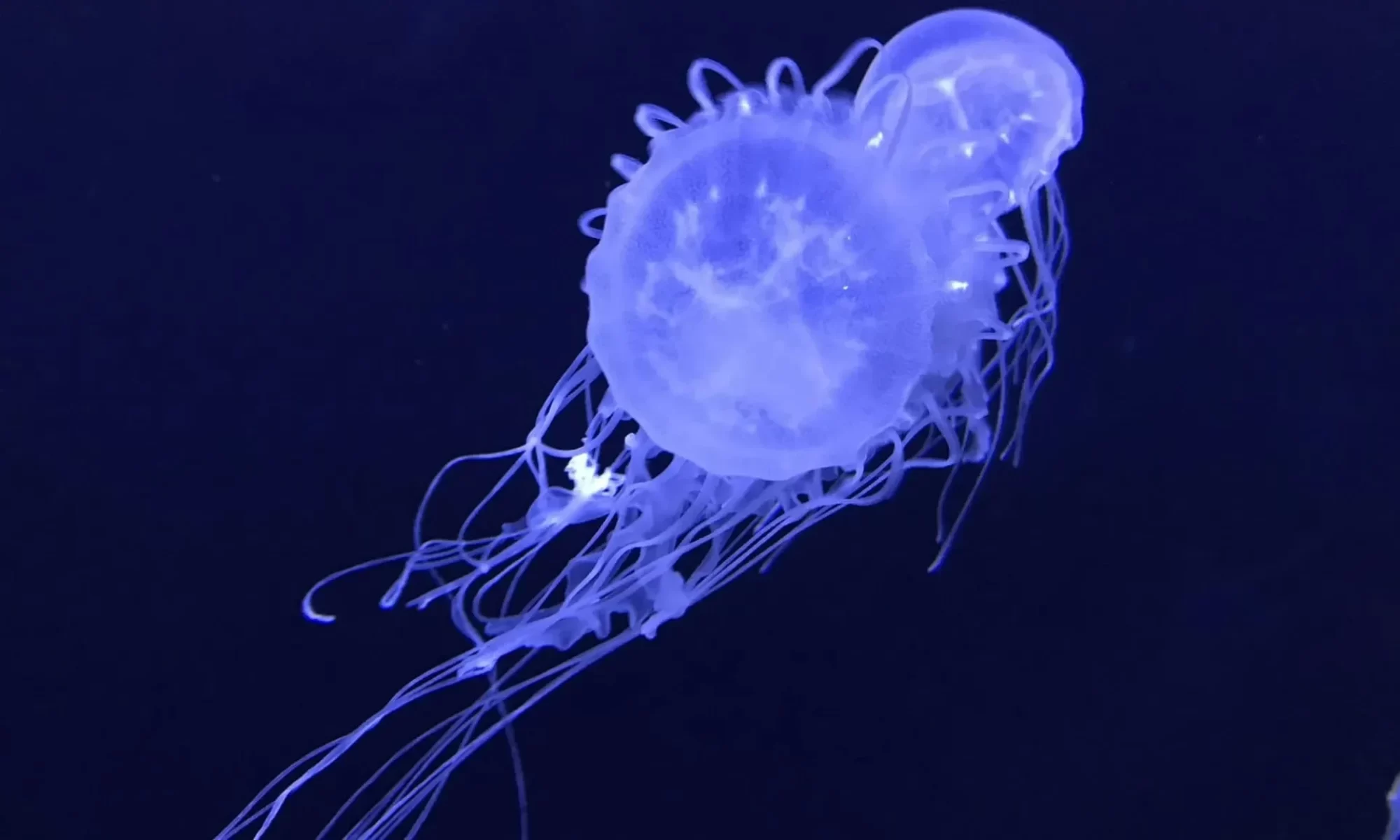
The #DesigningTheFuture3 expedition, led by Dr. Karen Osborn from the Smithsonian National Museum of Natural History, is utilizing novel technologies mounted on ROV SuBastian and within the onboard labs of R/V Falkor (too). These tools include EyeRIS and DeepPIV from the MBARI Bioinspiration Lab. These advanced imaging systems allow scientists to create detailed portraits of animals in their natural environment. Our lab took part in this expedition, working in the onboard laboratory as part of the OceanShot effort.
Have you ever encountered a jellyfish while walking along the beach, been captivated by their translucent beauty at an aquarium or maybe felt the stinging sensation of their venom while swimming or snorkeling in the sea?
I was fascinated by jellyfish during my first visit to Monterey Bay Aquarium (California USA), which has led to a life-long pursuit of studying these amazingly diverse and complex aquatic organisms. My travels have taken me around the globe, introduced me to the world’s leading researchers and further developed my passion for jellyfish research. Now as a Professor of Applied Marine Biology at Tohoku University (Sendai, Japan), I have the privilege of training the next generation of leaders who will carry this scientific field into new frontiers.
For those of you interested in learning more about jellyfish and my research collaborations, I hope you will find the information here both interesting and useful. If you are a student please consider studying Applied Marine Biology in my International Marine Sciences Laboratory at Tohoku University in Sendai, Japan. The ocean awaits, Meet the Lab!


Check out the latest lab updates.
- Tohoku University Museum exibit July 29th to 30th, “A New Species of Jellyfish from Sendai Bay: Portuguese Man-of-War”.
 During the open campus period, the Tohoku University Museum will feature a mini-exhibition showcasing a live specimen of a new species of Portuguese man-of-war, “Mikazuki-no-eboshi,” discovered in Sendai Bay. Known for its blue, transparent swim bladder and long, venomous tentacles, the Portuguese man-of-war had never been officially recorded along the northern coast of Japan before. A research team led by Professor Cheryl Ames and Professor Ogoshi from the Graduate School of Agricultural Science at our university identified the species found in Sendai Bay, revealing that it is distinct from other known species in the Portuguese man-of-war genus. This new species …
 - New species of venomous box jellyfish discovered off the coast of Sentosa – straitstimes.com/singapore –
 SINGAPORE – Researchers from Singapore and Japan have discovered a new species of box jellyfish near Sentosa, and have advised beachgoers to take precautions. This is the first discovery of a jellyfish of the Chironex genus since 2017, adding a new species to one of the world’s most venomous animal groups. The researchers from Tohoku University and the National University of Singapore’s Lee Kong Chian Natural History Museum and Tropical Marine Science Institute have named this new species Chironex blakangmati, after Sentosa’s original name: Pulau Blakang Mati, or Island of Death Behind. Find out more on the Straits Times website; Read the original scientific paper here;
 - 31 New Species Discovered in Two Weeks of Deep Sea Exploration -schmidtocean.org-
 Fortaleza, Brazil— An international team of midwater experts on board Schmidt Ocean Institute’s research vessel Falkor (too) discovered over two dozen new marine species on a recent expedition off the coast of Brazil in the tropical South Atlantic Ocean. The scientists used advanced technologies to explore the Ocean’s midwater — the water between the sunlit layer and the seafloor — which is Earth’s largest and least explored habitable ecosystem. It can take scientists decades to identify and describe new species, but the combination of technology and expertise enabled the team to confirm these species as new within a matter of days. Find the full …
Continue reading “31 New Species Discovered in Two Weeks of Deep Sea Exploration -schmidtocean.org-“
- Beyond the Sting: Box Jellyfish Reveal Diverse and Complex Reproduction – tohoku.ac.jp/en/press –
 Access the tohoku university press release here
 - Comparative gonadal histology reveals complex reproductive traits in Cubozoa (Cnidaria: Medusozoa) – Frontiers –
 New Lab Publication, Led by Dr. Jimena Garcia-Rodriguez Cubozoa, a relatively small class within Medusozoa (Cnidaria), is distinguished by its complex sexual behaviors, setting it apart from other medusozoan classes. However, reproductive traits and seasonality remain poorly characterized for many species, largely due to difficulties in obtaining specimens. In this comparative histological study we describe the reproductive tissues (gonads) of males and females at multiple maturity stages across 15 cubozoan species, representing two orders, seven families, and eight genera. We document several reproductive traits: (1) variation in oocyte shape, including polygonal oocytes; (2) unidentified cytoplasmic inclusions within oocytes suggestive of …