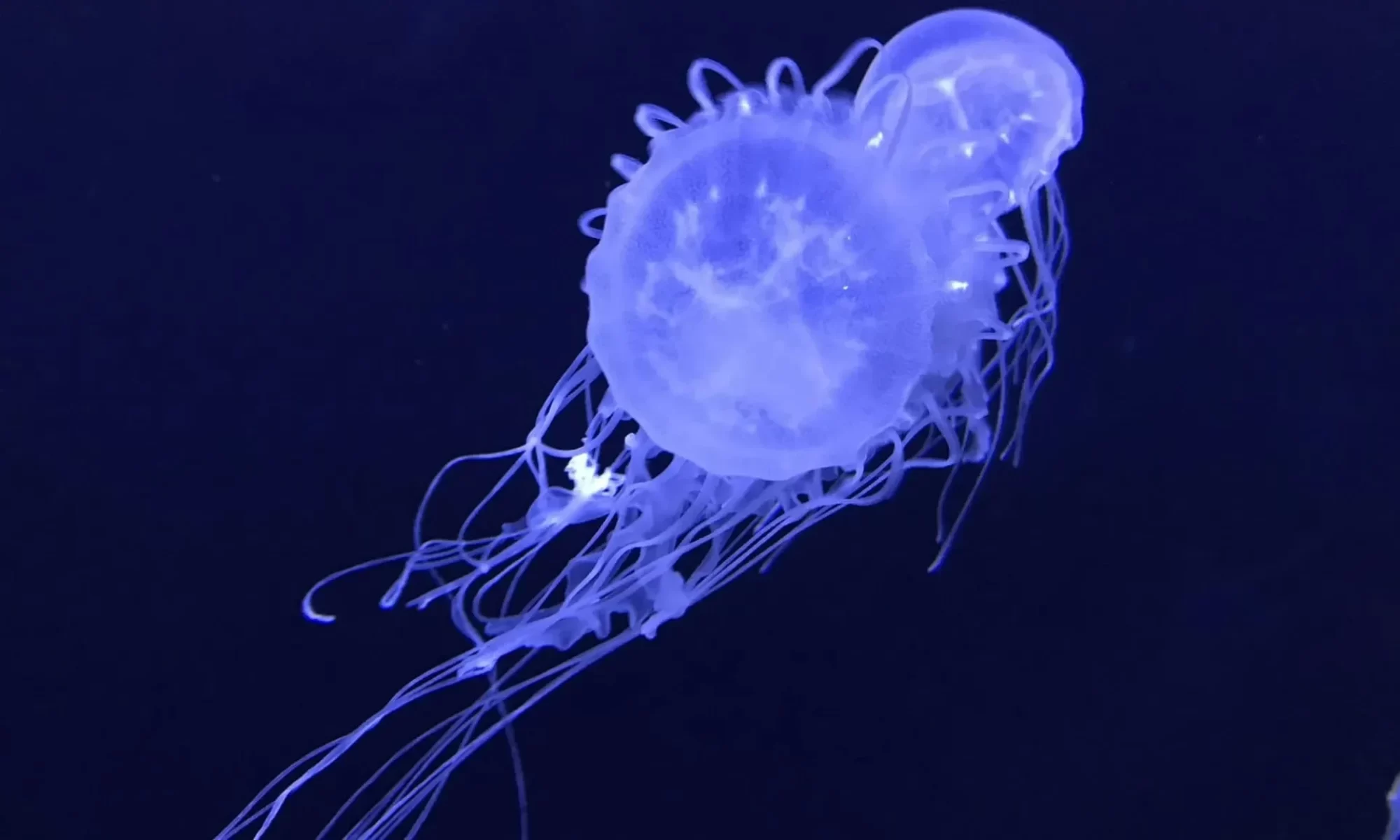
In a rare marine encounter, researchers in Japan have uncovered a previously unidentified species of Portuguese man-of-war, Physalia mikazuki, off the coast of northeastern Japan. This marks the first time such a venomous jellyfish has been documented so far north in the country, with experts tying its arrival to warmer waters and changing currents.
A new species of Portuguese man o’ war has been discovered floating in the waters of northeast Japan. Spotted by a student-led research group, the discovery marks a species that has never been seen before in the area, raising questions about shifting distributions of marine creatures due to the effects of climate change.
The lab work is making a big impact in the media. We are proud to display the media coverage here and you can access the complete story on the IFLScience website.
Our recent research paper, detailing the discovery of a new venomous jellyfish species in Japan, has captured international media attention, with outlets highlighting the fascinating cultural connection of its name and its critical implications for marine science.
The discovery, published in Frontiers in Marine Science, confirms the existence of Physalia mikazuki sp. nov.—a new type of Portuguese Man-of-War found unexpectedly far north in Japan’s Tohoku region.
A Name Worthy of a Warrior
The media coverage, including articles from Tohoku University, Asia Research News, and ScienceDaily, emphasized the unique story behind the new species’ name. The jellyfish was named P. mikazuki (“crescent helmet man-o-war”) as an homage to the legendary samurai warrior and feudal lord of Sendai, Date Masamune, who was famous for the crescent moon (mikazuki) adorning his helmet.
This culturally significant name drew attention to a serious scientific finding: the species’ arrival in the temperate Tohoku region is a direct result of marine ecosystem change.
Climate Change Drives Species North
The research, led by a team including Cheryl Lewis Ames, Chanikarn Yongstar, Kei Chloe Tan, and Ayane Totsu, suggests that warming coastal waters and the northward shift of the Kuroshio Current are pushing tropical species into previously untouched temperate zones. The study used DNA analysis and particle simulation modeling (as highlighted by the coverage) to confirm the species is distinct and to track its probable drift path from warmer waters.
This finding serves as a powerful indicator of how climate change is rapidly altering the global distribution of marine organisms, necessitating increased monitoring to ensure coastal safety and ecological understanding.
Tohoku University stands at the forefront of tackling some of the most pressing global challenges, particularly those related to our planet’s changing marine ecosystems. The Tohoku University Integrated Report 2024 highlights groundbreaking research and initiatives that aim to understand and mitigate the impacts of environmental shifts on ocean life and beyond.
Unraveling Marine Ecosystems with Environmental DNA
At the heart of marine research is Professor Cheryl Ames, Unit Leader/Principal Investigator at the Advanced Institute for Marine Ecosystem Change (WPI-AIMEC) and Professor at the Graduate School of Agricultural Science. Professor Ames’s research, which notably began with her fascination for jellyfish, has evolved into broader marine organismal studies utilizing environmental DNA (eDNA) analysis.
eDNA, collected from the environment (like seawater), provides a snapshot of all organisms inhabiting an ecosystem at a specific time, even revealing the environmental burden imposed by human activities. Professor Ames has developed a compact, portable eDNA detection kit, significantly reducing the time and cost associated with estimating jellyfish distribution over wide areas. This versatile kit can also be adapted to extract biological data from various other marine organisms.
Collaborations are key to this research. Professor Ames’s unit works with octopus fishers and wholesale auction centers in Minamisanriku, Miyagi, collecting eDNA to aid resource management in Shizugawa Bay and contribute to food sustainability. Further efforts are underway in Okinawa to develop rapid eDNA tests, crucial for regions where jellyfish damage impacts human health and tourism
Addressing Earth’s Changes and Shaping Ocean Life
WPI-AIMEC was established with a strong sense of urgency to decipher the mechanisms behind ocean warming and connect this understanding to projection models. The institute acknowledges the increasing vulnerability of marine ecosystems to rapid changes, suchando as rising global ocean temperatures and fluctuating ocean currents. Incidents like the mass outbreak of venomous Portuguese man-of-war in Miyagi Prefecture underscore the unprecedented phenomena occurring in our oceans.
Understanding the ocean requires an integrated approach, encompassing physics, chemistry, biology, and ecosystems, rather than isolated disciplinary studies. Tohoku University facilitates multidisciplinary research, bringing together diverse specializations to explore connections between sub-disciplines and gain a better understanding of the overall mechanisms of the ocean environment. The ultimate goal is to understand the relationship between the ocean and ecosystems, providing options for actions to build a sustainable society capable of adapting to environmental and ecological changes.
WPI-AIMEC aims to leverage AI to integrate various data types, enhancing our understanding of marine environments and the interactions between marine ecosystems and human society. The establishment of a centralized repository for valuable marine samples and their metadata (including eDNA sequences and images) is also a key initiative to invigorate marine ecology research. Outreach efforts include workshops for researchers and engaging elementary school students in eDNA sample collection to foster ocean conservation.
Tohoku University’s commitment to pioneering research in marine science, exemplified by Professor Ames’s work and the WPI-AIMEC initiative, is vital for a sustainable future.
The national university in the northeastern Japan prefecture of Miyagi is set to be formally selected as early as fiscal 2024 as a recipient of annual financial support for up to 25 years from fiscal 2024, starting with around 10 billion yen ($69 million) in the initial year.
Under the new Universities for International Research Excellence program, the grants will be paid out of profits generated from a 10 trillion yen fund.
Tohoku University has been rated highly for its large number of research paper citations, and measures to strengthen its research capabilities and reform its management, the ministry said.
Our team at Tohoku University, led by Associate Professor Alyne Delaney, just launched SEAQUEST – a vital research project tackling the complex challenges facing fisheries in Japan’s Tohoku region since the 2011 earthquake.
We’re blending cutting-edge science, like eDNA and AI for species distribution modeling, with traditional socio-ecological concepts like satoumi and umigyo. This holistic approach helps us understand why some fisheries have declined while others increased, especially with changing ocean conditions and parasitic outbreaks.
SEAQUEST emphasizes community-based citizen science, collecting crucial data from simple water samples. We’re working closely with diverse local and international stakeholders, including fishing communities (even women fishers!), tourism, and industry partners.
Our goal? To combine local ecological knowledge with scientific methods to foster true social and environmental sustainability. Co-Principal Investigators Professor Cheryl Ames and Associate Professor Toyonobu Fujii are key to this interdisciplinary effort.
With octopus, squid, and cuttlefish catches soaring but misidentification and inaccurate reporting raising overfishing fears, our international, multidisciplinary team is stepping in. Led by Tohoku University’s own Cheryl Ames (Co-Principal Investigator and Smithsonian Research Collaborator) and Demian Willette from Loyola Marymount University, our 15-member team spans 7 countries and diverse fields, including fisheries management, marine biology, and AI. Associate Professor Alyne Delaney (Tohoku University) is also on board!
Funded by the National Science Foundation, we’re building an application to track and identify octopus from ocean to table. This project uniquely combines traditional methods with cutting-edge tech: genomics, molecular metabarcoding, eDNA, and AI. Fishers in Mexico, California, and Alaska will be key citizen scientists, using eDNA kits to help us map octopus distribution and seasonality.
“Reliable knowledge will point us to where edible octopuses are found, and policymakers can use this information to make octopus fishing sustainable,” says Ames. We’re confident this network will pave the way for ecosystem-based fisheries and contribute to a thriving blue economy.
The Smithsonian Magazine that takes you behind the scenes at the National Museum of Natural History! The piece shines a spotlight on the museum’s unique “AquaRoom” a dedicated facility where live jellyfish and other marine invertebrates are raised and studied.
The AquaRoom, co-founded by marine biologists Allen Collins and Dr. Cheryl Ames, had humble beginnings but a grand vision. As Allen Collins recounts,
“So, Cheryl and I started collecting freebie aquarium stuff that people were getting rid of in the department, including a 55-gallon tank.”
From these dedicated efforts, the facility grew to cultivate various jellyfish species and became instrumental in educational outreach, offering tours, bringing live jellyfish to the museum floor, and continuing its mission through virtual webinars and collaborations, even sending jellyfish polyps for student experiments.