Beyond the Sting: Box Jellyfish Reveal Diverse and Complex Reproduction – tohoku.ac.jp/en/press –

“Thanks to the help of our international collaborators and access to curated museum collections, we were able to obtain specimens to unravel the mystery behind the complicated reproductive processes of these jellyfish.” Jimena Garcia-Rodriguez

In this study, a research team examined reproductive traits of box jellyfish (Cnidaria: Cubozoa), by analyzing preserved samples from multiple species collected in different regions of the world. Using histology – a technique that allows researchers to study tissues at a microscopic level – they investigated how sperm and eggs develop. These results provide new insights into the reproductive biology of this poorly understood group and help explain how different species function within their ecosystems, which is important for managing their impact on coastal activities and improve predictions of when and where they will appear.

This international collaboration brings together researchers from Tohoku University, the University of São Paulo, the Smithsonian Institution, and European partners like University of Alicante. This work represents one of the most comprehensive studies of reproduction in box jellyfish to date.

Access the full publication here

Access the tohoku university press release here

Comparative gonadal histology reveals complex reproductive traits in Cubozoa (Cnidaria: Medusozoa) – Frontiers –

New Lab Publication, Led by Dr. Jimena Garcia-Rodriguez

Cubozoa, a relatively small class within Medusozoa (Cnidaria), is distinguished by its complex sexual behaviors, setting it apart from other medusozoan classes. However, reproductive traits and seasonality remain poorly characterized for many species, largely due to difficulties in obtaining specimens. In this comparative histological study we describe the reproductive tissues (gonads) of males and females at multiple maturity stages across 15 cubozoan species, representing two orders, seven families, and eight genera. We document several reproductive traits: (1) variation in oocyte shape, including polygonal oocytes; (2) unidentified cytoplasmic inclusions within oocytes suggestive of undescribed component of vitellogenesis; (3) swollen gonadal structures in mature males, hinting at an uncharacterized spawning mechanism; and (4) a diverse repertoire of nematocysts within gonadal tissues, including putative nematoblasts in species of both cubozoan orders, indicating distinct developmental pathways for these organelles. Ancestral state reconstruction of three reproductive characters, viz. oocytes with unidentified cytoplasmic inclusions, the presence of nematocysts in gonads, and fertilization mode, suggests that all but the latter likely evolved independently within Cubozoa. By uncovering and characterizing these novel sexual traits in cubozoan jellyfishes, this study provides fundamental baseline data for comparative analyses aimed at elucidating the diversity and evolution of reproductive strategies across medusozoan taxa and their roles in spawning aggregations, also known as jellyfish blooms.

Access the full publication here

New box jellyfish name warns of ‘death from behind’ -popsci.com-

The new article from -Pooular Science- foucus a litle more at the Chironex gender and its facinating features like its swimming abitity and its complex eye organs.

“Canals or not, they are remarkable creatures. The vast majority of jellyfish don’t rely on vision and passively float in ocean currents, but members of the Chironex genus do not. Instead, they have evolved complex eye organs that help them locate prey. They then use that same musculature supported by the perradial lappets to actively swim through the water towards its target.”

Read their full article here:

Read the full scientific paper here:

Highly Venomous Box Jellyfish Species Found Off Singapore Waters -wakeup.sg-

The new discovery is raising concerns in Singapore. Several news articles have surged since the announcement. Wake Up Singapore’s coverage focuses on concerns about a perceived shift in box jellyfish populations across Southeast Asia and their potential danger to swimmers.

The article also focuses on the naming of the new species: Chironex blakangmati, named after the island’s historical Malay name, Pulau Blakang Mati, meaning “Island of Death Behind.” It becomes the fourth known species in the deadly Chironex genus, a group of jellyfish whose stings can be fatal within minutes.

Read the wakeup.sg take on the new species discovery here:

Read the full cientific paper here:

New species of venomous box jellyfish discovered in Singapore waters, dubbed after Sentosa’s historical Malay name -theindependent.sg-

The discovery of a new box jellyfish species in Singaporean waters is making headlines in Singapore!

A news article from the Singaporean news outlet The Independent Singapore, written by Jewel Stolarchuk, covers the fascinating history behind the finding of this new species. It details how a long-standing case of “mistaken identity” was finally resolved through DNA analysis and morphological distinction.

The new species initially closely resembled Chironex yamaguchii—a jellyfish Dr. Cheryl Ames had previously discovered in Okinawa during her master’s studies.

“But we realized they were completely distinct,” said Dr. Cheryl Ames.

Chek out the complete news article here

Read more about the scientific paper here

New Species of Venomous Box Jellyfish Discovered in Singapore: Tohoku University Press Release

Published in: Raffles Bulletin of Zoology (May 15, 2026)

Collaborative Research: Tohoku University & National University of Singapore

For decades, the multi-tentacled box jellyfishes—colloquially known as “sea-wasps”—found lurking in Southeast Asian waters were a mystery. Often misidentified or overlooked due to subtle physical differences, these animals carry a sting that is excruciatingly painful and potentially fatal. Now, a major breakthrough co-authored by Cheryl Lewis Ames has formally rewritten the region’s marine biology records.

Read the full story in the Tohoku University press release:

Reade the full article at: Raffles Bulletin of Zoology

Chironex box jellyfishes (Cnidaria: Cubozoa: Chirodropida) in Singapore: Chironex blakangmati, new species, and range extension of C. indrasaksajiae

New Discovery: A New Species of Deadly Box Jellyfish Uncovered!

Iffah Iesa, Cheryl Lewis Ames, Nicholas Wei Liang Yap & Danwei Huang

Abstract. Two venomous box jellyfish species of the genus Chironex Southcott, 1956 (Cnidaria: Cubozoa: Chirodropida) were collected from Singapore’s coastal waters: Chironex indrasaksajiae Sucharitakul, 2017 and a novel species described herein as Chironex blakangmati, new species.
Chironex indrasaksajiae was collected from both the Johor and Singapore Straits around mainland Singapore. Chironex blakangmati, new species, was collected from Sentosa Island along the Singapore Strait and is the fourth species described in the genus. While Cblakangmati’s volcano-shaped pedalial canal and tentacle number are similar to Cyamaguchii Lewis & Bentlage, 2009, its elongated, sharp-tipped velarial canals and DNA sequences distinguish it from other Chironex species. Comparisons of Chironex blakangmati, new species, with C. yamaguchii and C. fleckeri
reveal novel morphological differences at the terminal end of the perradial lappet along the velarium edge, where C. blakangmati, new species, lacks velarial canals extending from the perradial lappet terminus. Juvenile Chironex yamaguchii specimens were examined and ontogenetic variations of velarial canals are herein reported. Preliminary cnidome analysis reveals eight types of nematocysts observed in C. blakangmati, new species, five types in C. indrasaksajiae, and five types in C. yamaguchii. Molecular phylogenetic reconstruction places C. blakangmati, new species, in a clade distinct from its congeners, as sister group to C. yamaguchii based on 16S rRNA gene analysis but diverging earlier than the clade comprising C. yamaguchii and C. indrasaksajiae based on cytochrome c oxidase subunit I gene analysis for which sequence data are comparatively limited. Understanding the biodiversity and seasonality of venomous cubomedusae will help mitigate the risk they pose to human health and safety during maritime activities.

Read the full article here: Raffles Bulletin of Zoology
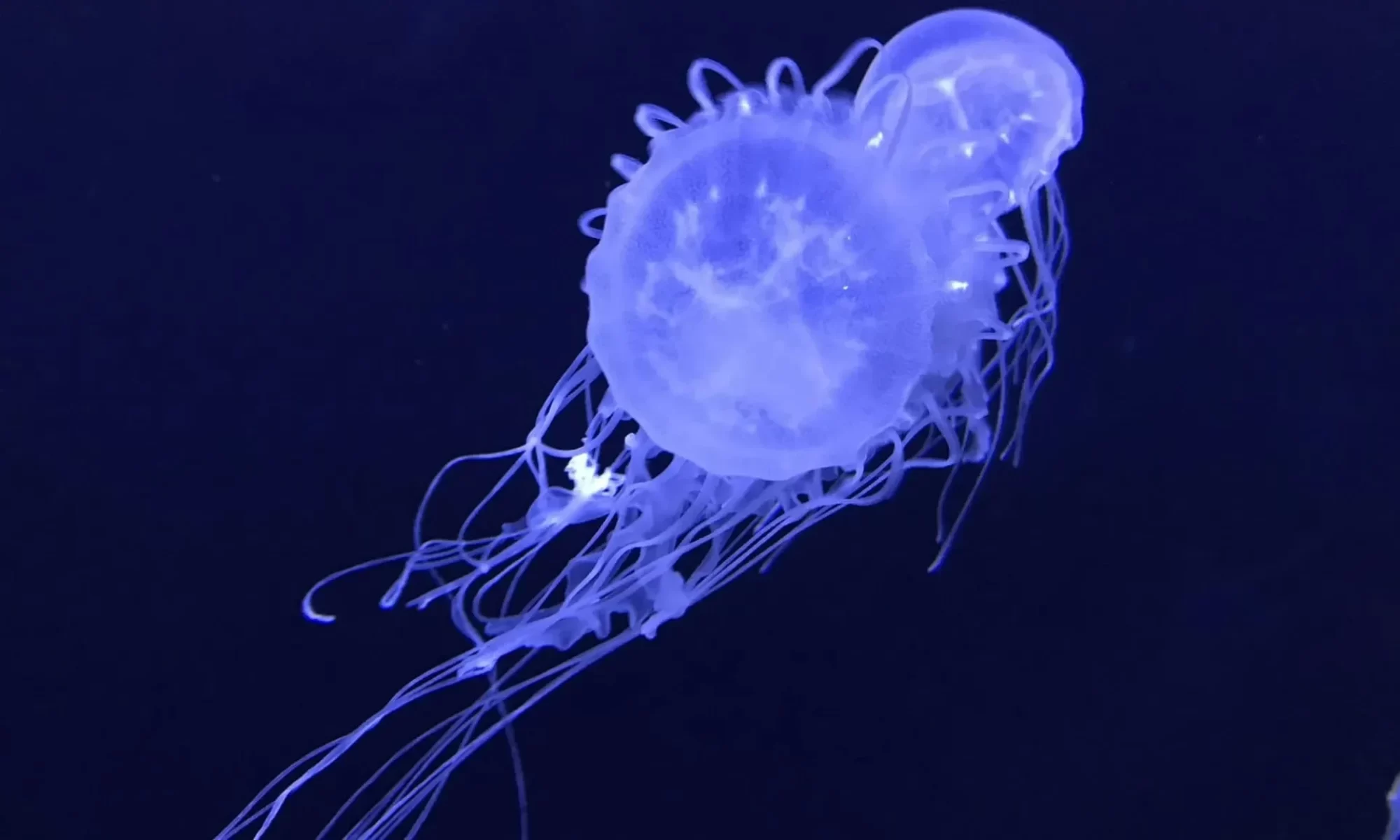
New Research: A comparative molecular study of rhizostome jellyfishes from Japan reveals variability in Symbiodiniaceae taxon associations and cassiosome production.

Led by Kei Chloe Tan , this study dives deep into the complex world of Rhizostomeae that play massive roles in Asian ecology and industry.

What makes these jellies unique?

Rhizostome jellyfishes are unlike your average medusa. They don’t have long, trailing tentacles neither other structures at the eadg of theyr bell; they have eight highly branched oral arms, along which there are suctorial minimouth orifices.

Our study focused on three main goals:

  • Identity: Using DNA barcoding to accurately identify species in Japanese waters.
  • Partnership: Mapping which types of algae live inside which jellyfish.
  • The Sting: Identifying which species produce cassiosomes—the “mucus grenades” responsible for the mysterious “stinging water” syndrome.

Key Discoveries

  • A New Neighbor: We discovered that Cassiopea (Upside-down jellyfish) found in Kagoshima likely represents a new, undescribed species.
  • Symbiotic Flexibility: We found that these jellyfishes are “plastic” in their partnerships, meaning the same species of jellyfish can host different types of algae (Symbiodinium, Cladocopium, or Durusdinium) depending on the individual.
  • The “Grenade” Evolution: We confirmed that cassiosome production is a unique trait of the suborder Kolpophorae. Interestingly, we found that young jellies might not produce them until they reach a certain developmental stage.

“This research provides a baseline for understanding how jellyfish and algae co-evolve, helping us manage coastal ecosystems and the jellyfish fisheries that are so vital to the region.”Chloe Tan, Lead Author

Lab Work in Action

This paper wasn’t just about sequences; it combined advanced molecular techniques with classic microscopy.

  • Tandem DNA Amplification: Chloe developed a new method to simultaneously sequence the DNA of both the jellyfish host and its tiny algal residents.
  • Microscopy: We captured high-resolution images of the cassiosomes—clusters of stinging cells (nematocysts) with algae at their core—proving exactly how these “contactless stings” work.

Read the Full Paper

Interested in the molecular data or the high-resolution phylogenetic trees? You can find the full study here:

Dr. Ames’s research

As an experienced research scientist, teacher and mentor, Dr. Ames employs a combination of molecular and morphological tools to address major scientific questions in the fields of behavior, ecology, evolution and systematics. Her research focuses on venomous box jellyfish and seeks to further understanding of this cosmopolitan aquatic organism.

Cheryl has extensive field research experience having worked around the world including in the United States, Canada, Japan, and numerous tropical and subtropical regions. She has a demonstrated ability to collaborate with top-level government and academic researchers and obtain funding for multidisciplinary research projects. While designing experiments and conceiving ideas for publications, she strives to develop projects that strike an even balance between fundamental and applied marine biology.

A selected list of major research works appears below. For a full list of all of her work and more information about her research please visit her Research Gate profile.

Raising Awareness of the Severity of “Contactless Stings” by Cassiopea Jellyfish and Kin

Current doctrine on jellyfish stings largely focuses on physical contact with a jellyfish. In rhizostome medusae capable of extruding agglomerations of nematocysts within mucus, physical contact is not necessary for skin irritation and pain. Here we highlight pain and symptoms reported by researchers and aquarists working with water around Cassiopea and several other jellyfish. We conclude that Cassiopea, long thought to be harmless, can lead to multi-day pain and rashes experienced largely as burning and itching sensations along entire limbs. We suggest that recommendations on sting avoidance expand to include consideration of these contactless stings so as to limit a previously under-publicized vector of envenomation.

Click here to access the full article.