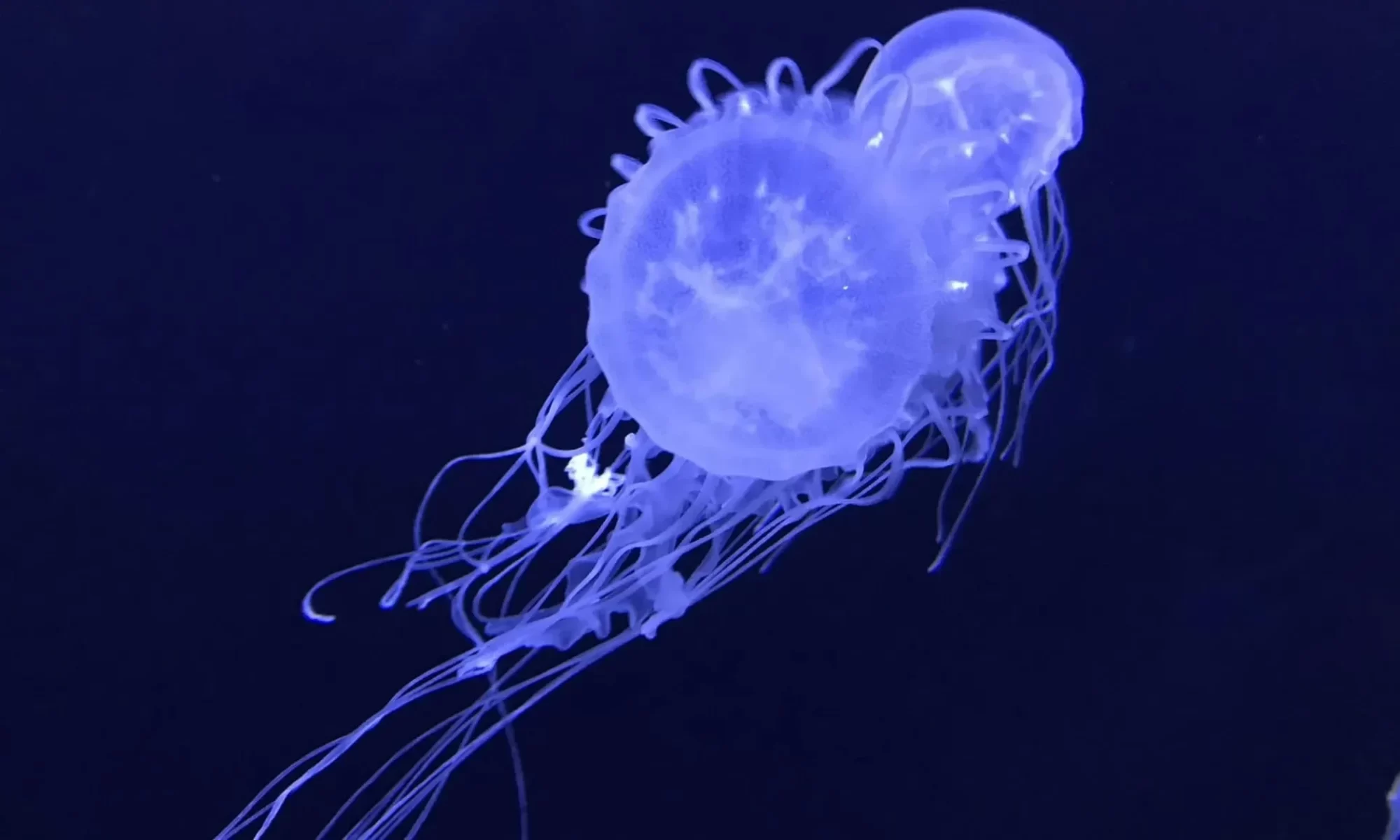
New Research: A comparative molecular study of rhizostome jellyfishes from Japan reveals variability in Symbiodiniaceae taxon associations and cassiosome production.

Led by Kei Chloe Tan , this study dives deep into the complex world of Rhizostomeae that play massive roles in Asian ecology and industry.

What makes these jellies unique?

Rhizostome jellyfishes are unlike your average medusa. They don’t have long, trailing tentacles neither other structures at the eadg of theyr bell; they have eight highly branched oral arms, along which there are suctorial minimouth orifices.

Our study focused on three main goals:

  • Identity: Using DNA barcoding to accurately identify species in Japanese waters.
  • Partnership: Mapping which types of algae live inside which jellyfish.
  • The Sting: Identifying which species produce cassiosomes—the “mucus grenades” responsible for the mysterious “stinging water” syndrome.

Key Discoveries

  • A New Neighbor: We discovered that Cassiopea (Upside-down jellyfish) found in Kagoshima likely represents a new, undescribed species.
  • Symbiotic Flexibility: We found that these jellyfishes are “plastic” in their partnerships, meaning the same species of jellyfish can host different types of algae (Symbiodinium, Cladocopium, or Durusdinium) depending on the individual.
  • The “Grenade” Evolution: We confirmed that cassiosome production is a unique trait of the suborder Kolpophorae. Interestingly, we found that young jellies might not produce them until they reach a certain developmental stage.

“This research provides a baseline for understanding how jellyfish and algae co-evolve, helping us manage coastal ecosystems and the jellyfish fisheries that are so vital to the region.”Chloe Tan, Lead Author

Lab Work in Action

This paper wasn’t just about sequences; it combined advanced molecular techniques with classic microscopy.

  • Tandem DNA Amplification: Chloe developed a new method to simultaneously sequence the DNA of both the jellyfish host and its tiny algal residents.
  • Microscopy: We captured high-resolution images of the cassiosomes—clusters of stinging cells (nematocysts) with algae at their core—proving exactly how these “contactless stings” work.

Read the Full Paper

Interested in the molecular data or the high-resolution phylogenetic trees? You can find the full study here:

Who’s in this Ocean? Tracking Down Species on the Go Using Environmental DNA

The article details the development of a novel method for tracking marine species: the portable eDNA sequencing kit (FeDS), spearheaded by Dr. Cheryl Lewis Ames’s team from Tohoku University. The article explains how the FeDS kit makes the complex process of environmental DNA identification — from water sample collection to species identification — entirely portable and capable of being conducted on-site without an internet connection, thanks to the Nanopore MinION device.

The effectiveness of the FeDS kit was successfully tested in the Florida Keys, where the team not only detected the upside-down jellyfish (Cassiopea) but also identified a remarkable 53 jellyfish species, including two venomous box jellyfish species previously unreported in the area. Dr. Ames envisions incredible practical applications for this technology, such as predicting jellyfish sting risks, much like a ‘weather forecast app’ for swimmers!

This innovative research was published in the esteemed Frontiers in Marine Science journal, underscoring its solid impact and global relevance.

To understand this groundbreaking innovation and how it’s shaping the future of marine life detection, read the full article on Asia Research News:

And to access the original scientific paper that underpins this research, click here:

Tracking Down Ocean Species On the Go Using eDNA

An image of the Smithsonian Museum logo

The article highlights the pioneering work of our own Dr. Cheryl Ames and her team in the Florida Keys. They led a crucial study demonstrating the potential of a portable Nanopore sequencer to detect the presence of upside-down jellyfish (Cassiopea xamachana) and other jellyfish species directly in the field! This represents an incredible leap forward, overcoming the challenges of bringing complex DNA analysis from labs into the marine environment.

This technology not only identified Cassiopea jellyfish but also revealed the presence of other species unseen at the time of sampling, such as moon jellyfish and venomous box jellyfish. The potential is vast: from predicting jellyfish sting risks to aiding fisheries management, supporting conservation efforts, and even integrating into autonomous underwater vehicles for comprehensive marine surveys.

This groundbreaking research stems from a foundational scientific paper published in Frontiers in Marine Science, underscoring its impact.

Read the full article on Smithsonian Ocean and dive into the future of species detection:

And for the original scientific paper that underpins this amazing work, access it here:

These jellyfish can sting without touching you, thanks to ‘mucus grenades’

Imagine encountering a creature that defends itself with unseen projectiles! National Geographic invites you on a journey into the remarkable world of upside-down jellyfish, showcasing Dr. Cheryl Ames’s extraordinary research into their unique defense strategy.

This captivating feature explores how these intriguing invertebrates, Cassiopea spp., can release ‘mucus grenades’ – microscopic, venom-filled structures that pack a potent sting without direct contact. Dr. Cheryl Ames, a marine biologist and associate professor at Tohoku University, provides a fascinating glimpse into the observation of these creatures’ efficiency:

“Then, within 24 hours, the pink cloud will be gone.” (referring to the cloud of zapped brine shrimp after feeding). This observation speaks volumes about the efficacy of their hidden defense system.

National Geographic beautifully illustrates how Dr. Ames’s profound contributions are reshaping our understanding of marine ecosystems and the intricate adaptations within them. It’s truly inspiring to see this deep dive into nature’s secrets featured by such a world-renowned publication, bringing the wonders of the ocean floor to life for millions worldwide.

Explore the National Geographic Story Here

Discover Dr. Ames’s Original Research Paper Here

Upside-down jellyfish release venom-filled ‘bombs’ in their snot

Mucus produced by these upside-down jellyfish can be seen floating above their frilly arms. (Image credit: Allen Collins and Cheryl Ames)

For years, swimmers have felt a perplexing tingling in waters inhabited by upside-down jellyfish, even without direct contact. Now, Live Science delivers the definitive scientific explanation, thanks to the pivotal research co-led by Dr. Cheryl Ames!

The long-standing question of what causes this ‘stinging water sensation’ has finally been addressed. As Dr. Cheryl Ames, an associate professor of applied marine biology at Tohoku University, explains the initial scientific challenge:

“We knew it had to be something in the mucus.”

Her team’s methodical investigation led to the identification of ‘cassiosomes’ – microscopic, venom-filled structures released by the jellyfish – providing the clear answer.

This compelling Live Science article details the journey of scientific inquiry, highlighting the rigorous process that unveiled nature’s hidden mechanisms. We’re proud to see Dr. Ames’s dedication to solving marine mysteries recognized by Live Science, bringing clarity and understanding to a broader audience.

Explore the Live Science Story Here

Discover Dr. Ames’s Original Research Paper Here

Upside-down Jellyfish Create ‘Stinging Water’ That Kills Prey by Launching Mucus ‘Grenades’

[This study] began when I and other marine biologists were concerned about the source of ‘stinging water’—an irritating sensation that occurred while in the mangrove forest waters studying upside-down jellyfish, and working together with aquarists at major public aquariums,” Cheryl Ames, an author of the study from Tohoku University, Japan, and the Smithsonian’s National Museum of Natural History, told Newsweek.

“There were several theories exchanged by fellow marine biologists, and comments posted online by people after experiencing stinging water during snorkeling or swimming in those areas. We wanted to find out the scientific explanation behind the long-standing stinging water puzzle,” she said.

Read the full story here

Cassiosomes are stinging-cell structures in the mucus of the upside-down jellyfish Cassiopea xamachana

Snorkelers in mangrove forest waters inhabited by the upside-down jellyfish Cassiopea xamachana report discomfort due to a sensation known as stinging water, the cause of which is unknown. Using a combination of histology, microscopy, microfluidics, videography, molecular biology, and mass spectrometry-based proteomics, we describe C. xamachana stinging-cell structures that we term cassiosomes. These structures are released within C. xamachana mucus and are capable of killing prey. Cassiosomes consist of an outer epithelial layer mainly composed of nematocytes surrounding a core filled by endosymbiotic dinoflagellates hosted within amoebocytes and presumptive mesoglea. Furthermore, we report cassiosome structures in four additional jellyfish species in the same taxonomic group as C. xamachana (Class Scyphozoa; Order Rhizostomeae), categorized as either motile (ciliated) or nonmotile types. This inaugural study provides a qualitative assessment of the stinging contents of C. xamachana mucus and implicates mucus containing cassiosomes and free intact nematocytes as the cause of stinging water. The discovery of cassiosomes is detailed in this paper

Click here to access the full article.

Click here to see the media impact of the discovery of cassiosomes