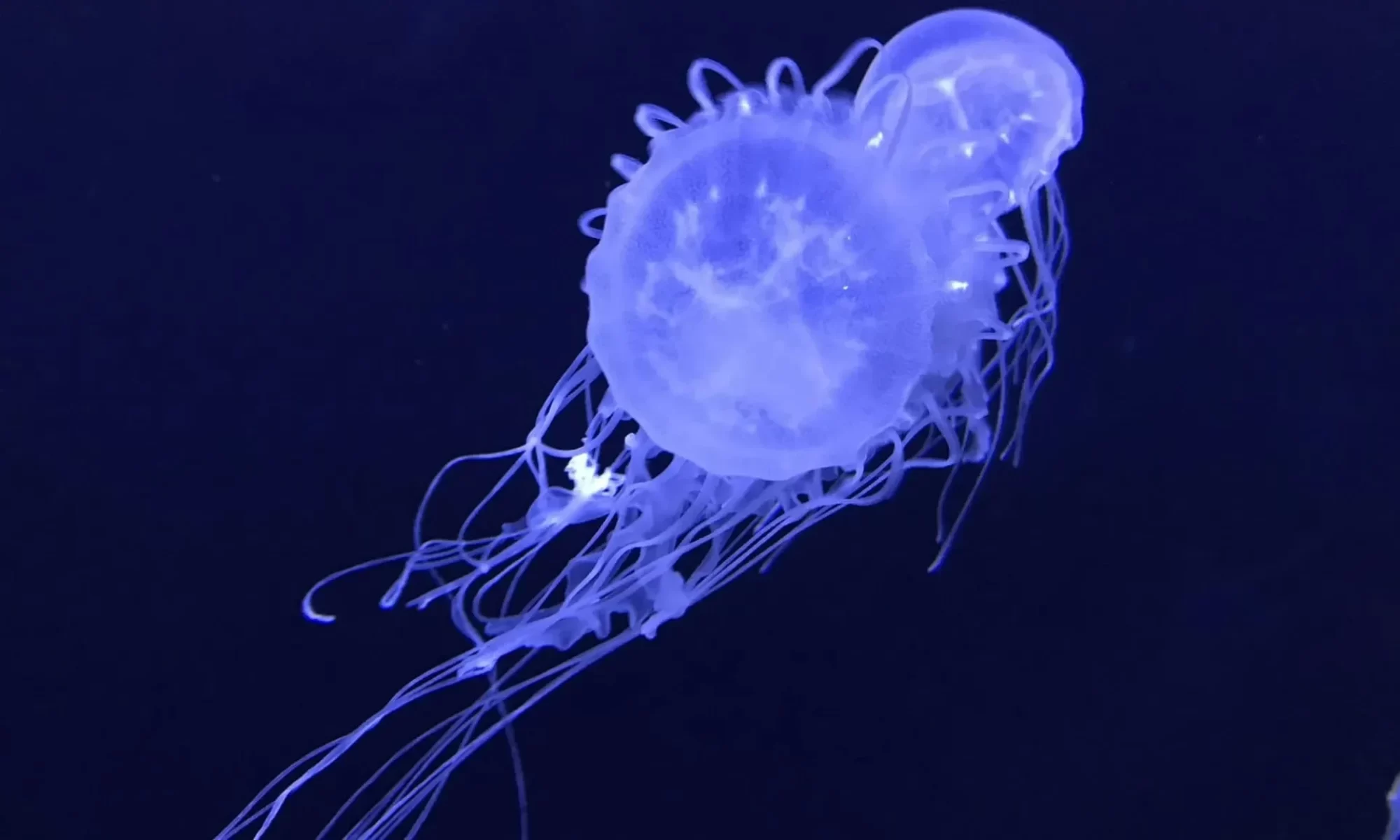
New, Venomous Portuguese Man-of-War Discovered in Japan’s North: Physalia mikazuki
This new species, named Physalia mikazuki (“crescent helmet man-o-war”) in honor of the samurai lord Date Masamune, marks the northernmost recorded presence of the Physalia genus to date, with specimens collected off the coast of northeastern Japan (Sendai Bay).
A student-led research team at Tohoku University (greatly formed by our lab) has formally identified a previously unknown species of the venomous siphonophore, Physalia —commonly known as the Portuguese man-of-war.
Key Scientific Findings:
New Species Identification: Through detailed morphological examination and genetic analysis, the team confirmed that P. mikazuki is genetically distinct from its tropical relatives, specifically Physalia utriculus, which was previously believed to be the only species of the genus inhabiting Japanese waters.
Climate-Driven Range Extension: The appearance of P. mikazuki in the colder waters of the Tohoku region suggests a significant shift in marine distribution. Ocean surface current simulations confirmed that the northward extension of the Kuroshio Current, combined with unusually high sea-surface temperatures, likely transported the colonies to Sendai Bay.
Ecological Significance: The discovery provides direct evidence that climate-related changes in ocean circulation are actively reshaping the distribution of marine species, highlighting the urgency of coastal observation.
The research not only adds a new species to the world’s taxonomic records but also underscores the immediate impact of climate change on ocean ecosystems, influencing where even dangerous marine life can drift and thrive.
In a rare marine encounter, researchers in Japan have uncovered a previously unidentified species of Portuguese man-of-war, Physalia mikazuki, off the coast of northeastern Japan. This marks the first time such a venomous jellyfish has been documented so far north in the country, with experts tying its arrival to warmer waters and changing currents.
A new species of Portuguese man o’ war has been discovered floating in the waters of northeast Japan. Spotted by a student-led research group, the discovery marks a species that has never been seen before in the area, raising questions about shifting distributions of marine creatures due to the effects of climate change.
The lab work is making a big impact in the media. We are proud to display the media coverage here and you can access the complete story on the IFLScience website.
Our recent research paper, detailing the discovery of a new venomous jellyfish species in Japan, has captured international media attention, with outlets highlighting the fascinating cultural connection of its name and its critical implications for marine science.
The discovery, published in Frontiers in Marine Science, confirms the existence of Physalia mikazuki sp. nov.—a new type of Portuguese Man-of-War found unexpectedly far north in Japan’s Tohoku region.
A Name Worthy of a Warrior
The media coverage, including articles from Tohoku University, Asia Research News, and ScienceDaily, emphasized the unique story behind the new species’ name. The jellyfish was named P. mikazuki (“crescent helmet man-o-war”) as an homage to the legendary samurai warrior and feudal lord of Sendai, Date Masamune, who was famous for the crescent moon (mikazuki) adorning his helmet.
This culturally significant name drew attention to a serious scientific finding: the species’ arrival in the temperate Tohoku region is a direct result of marine ecosystem change.
Climate Change Drives Species North
The research, led by a team including Cheryl Lewis Ames, Chanikarn Yongstar, Kei Chloe Tan, and Ayane Totsu, suggests that warming coastal waters and the northward shift of the Kuroshio Current are pushing tropical species into previously untouched temperate zones. The study used DNA analysis and particle simulation modeling (as highlighted by the coverage) to confirm the species is distinct and to track its probable drift path from warmer waters.
This finding serves as a powerful indicator of how climate change is rapidly altering the global distribution of marine organisms, necessitating increased monitoring to ensure coastal safety and ecological understanding.
A groundbreaking study co-authored by Cheryl Lewis Ames, Chanikarn Yongstar, Kei Chloe Tan, Ayane Totsu, and colleagues, has led to the identification of a new species of Portuguese Man-of-War (Physalia mikazuki sp. nov.) found in the waters of northeastern Japan (Tohoku).
The research, which also contou com Yoshiki Ochiai, Muhammad Izzat Nugraha, e Waka Sato-Okoshi, attributes the sudden presence of this new species in the temperate region to significant marine ecosystem changes. This discovery is vital for understanding how environmental shifts—such as changes in currents and climate—are forcing the global redistribution of marine organisms.
The findings emphasize the urgent need to monitor these shifts to protect marine biodiversity.
Authors: Chanikarn Yongstar, Yoshiki Ochiai, Muhammad Izzat Nugraha, Kei Chloe Tan, Ayane Totsu, Waka Sato-Okoshi, Cheryl Lewis Ames
As an experienced research scientist, teacher and mentor, Dr. Ames employs a combination of molecular and morphological tools to address major scientific questions in the fields of behavior, ecology, evolution and systematics. Her research focuses on venomous box jellyfish and seeks to further understanding of this cosmopolitan aquatic organism.
Cheryl has extensive field research experience having worked around the world including in the United States, Canada, Japan, and numerous tropical and subtropical regions. She has a demonstrated ability to collaborate with top-level government and academic researchers and obtain funding for multidisciplinary research projects. While designing experiments and conceiving ideas for publications, she strives to develop projects that strike an even balance between fundamental and applied marine biology.
A selected list of major research works appears below. For a full list of all of her work and more information about her research please visit her Research Gate profile.
The Asia-Pacific Region (APR) is a global hub of marine biodiversity, essential for global ecological stability and climate regulation. However, its ecosystems from extensive commercial fisheries to vital coral reefs face growing threats due to intense resource extraction and extreme climate events, such as marine heatwaves.
This Perspective article, led by an international collaboration (including Dr. Cheryl Ames), is the result of a seminar and workshop held at Tohoku University (Japan) in 2023. The goal was to address substantial barriers—including the vast diversity of cultures, languages, and management practices—that impede cross-national research efforts in the region.
The article concludes that these efforts are urgent and essential for supporting science-based policies and decisions, capable of confronting the escalating effects of climate change on the Pacific Asian marine systems.
“Without shared, high-quality data, our ability to detect patterns, predict outcomes, and guide effective action remains severely constrained.”
“A productive way forward is to build on regional initiatives that are already redefining how marine science is approached in the Asia-Pacific. This effort aligns with the goals of the World Premier International Research Centre Initiative-Advanced Institute for Marine Ecosystem Change (WPI-AIMEC), recently established at Tohoku University and Japan Agency for Marine-Earth Science and Technology (JAMSTEC), and a satellite campus at the University of Hawai’i, Manoa. WPI-AIMEC brings together researchers across disciplines to better understand and forecast marine ecosystem responses to environmental change, with a global scope but a particular focus on the Northwest Pacific.”
Find the Full Paper at Frontiers in Marine Science
Tohoku University released its new site design, with a lighter theme and clear lines. The new design is looking really good, but the biggest news for us is that our lab is featured on the front page.
Under the title, “The Romance of Research: Cheryl Ames,” there is an interview with Dr. Ames with text by Taylor Brin that showcases her motivation and ideals put into practice in the collaborative environment that is our lab.
“The Romance of Research: Cheryl Ames” is a really good read, and we are really proud of being portrayed on the new Tohoku University front page.
Behind every breakthrough and exciting discovery at the International Marine Science Lab is a dedicated, international team. We’re excited to introduce our new “Meet the Lab” page, giving you a closer look at the diverse talents, backgrounds, and personalities that make our research community so vibrant.
Learn about their expertise, their roles, and what makes our lab a place of great work and cutting-edge research.
Get to know our incredible team: You can access the page directly via the link below, or through the new “Meet the Lab” icon in our website menu!
Tohoku University stands at the forefront of tackling some of the most pressing global challenges, particularly those related to our planet’s changing marine ecosystems. The Tohoku University Integrated Report 2024 highlights groundbreaking research and initiatives that aim to understand and mitigate the impacts of environmental shifts on ocean life and beyond.
Unraveling Marine Ecosystems with Environmental DNA
At the heart of marine research is Professor Cheryl Ames, Unit Leader/Principal Investigator at the Advanced Institute for Marine Ecosystem Change (WPI-AIMEC) and Professor at the Graduate School of Agricultural Science. Professor Ames’s research, which notably began with her fascination for jellyfish, has evolved into broader marine organismal studies utilizing environmental DNA (eDNA) analysis.
eDNA, collected from the environment (like seawater), provides a snapshot of all organisms inhabiting an ecosystem at a specific time, even revealing the environmental burden imposed by human activities. Professor Ames has developed a compact, portable eDNA detection kit, significantly reducing the time and cost associated with estimating jellyfish distribution over wide areas. This versatile kit can also be adapted to extract biological data from various other marine organisms.
Collaborations are key to this research. Professor Ames’s unit works with octopus fishers and wholesale auction centers in Minamisanriku, Miyagi, collecting eDNA to aid resource management in Shizugawa Bay and contribute to food sustainability. Further efforts are underway in Okinawa to develop rapid eDNA tests, crucial for regions where jellyfish damage impacts human health and tourism
Addressing Earth’s Changes and Shaping Ocean Life
WPI-AIMEC was established with a strong sense of urgency to decipher the mechanisms behind ocean warming and connect this understanding to projection models. The institute acknowledges the increasing vulnerability of marine ecosystems to rapid changes, suchando as rising global ocean temperatures and fluctuating ocean currents. Incidents like the mass outbreak of venomous Portuguese man-of-war in Miyagi Prefecture underscore the unprecedented phenomena occurring in our oceans.
Understanding the ocean requires an integrated approach, encompassing physics, chemistry, biology, and ecosystems, rather than isolated disciplinary studies. Tohoku University facilitates multidisciplinary research, bringing together diverse specializations to explore connections between sub-disciplines and gain a better understanding of the overall mechanisms of the ocean environment. The ultimate goal is to understand the relationship between the ocean and ecosystems, providing options for actions to build a sustainable society capable of adapting to environmental and ecological changes.
WPI-AIMEC aims to leverage AI to integrate various data types, enhancing our understanding of marine environments and the interactions between marine ecosystems and human society. The establishment of a centralized repository for valuable marine samples and their metadata (including eDNA sequences and images) is also a key initiative to invigorate marine ecology research. Outreach efforts include workshops for researchers and engaging elementary school students in eDNA sample collection to foster ocean conservation.
Tohoku University’s commitment to pioneering research in marine science, exemplified by Professor Ames’s work and the WPI-AIMEC initiative, is vital for a sustainable future.