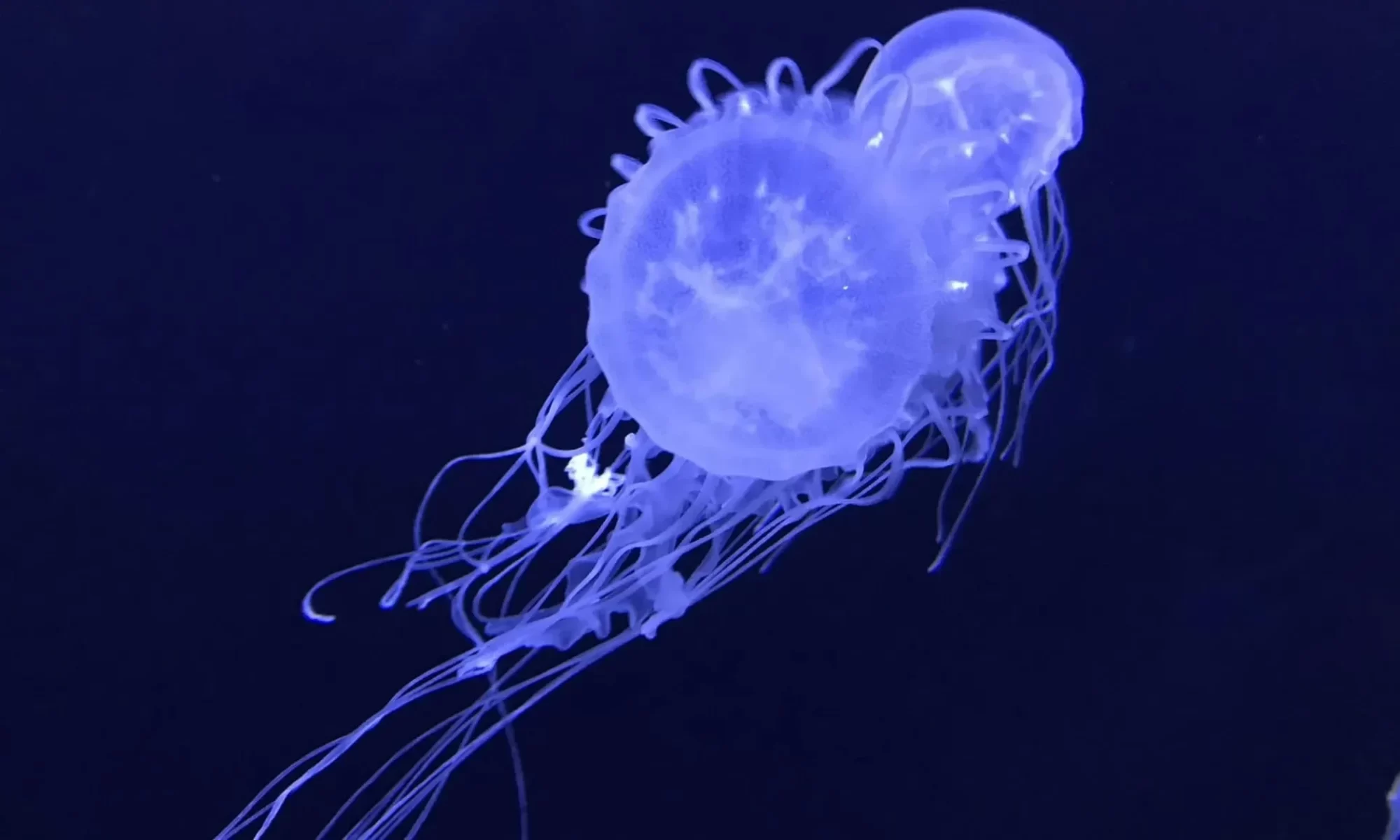
“Thanks to the help of our international collaborators and access to curated museum collections, we were able to obtain specimens to unravel the mystery behind the complicated reproductive processes of these jellyfish.” Jimena Garcia-Rodriguez
In this study, a research team examined reproductive traits of box jellyfish (Cnidaria: Cubozoa), by analyzing preserved samples from multiple species collected in different regions of the world. Using histology – a technique that allows researchers to study tissues at a microscopic level – they investigated how sperm and eggs develop. These results provide new insights into the reproductive biology of this poorly understood group and help explain how different species function within their ecosystems, which is important for managing their impact on coastal activities and improve predictions of when and where they will appear.
This international collaboration brings together researchers from Tohoku University, the University of São Paulo, the Smithsonian Institution, and European partners like University of Alicante. This work represents one of the most comprehensive studies of reproduction in box jellyfish to date.
New Lab Publication, Led by Dr. Jimena Garcia-Rodriguez
Cubozoa, a relatively small class within Medusozoa (Cnidaria), is distinguished by its complex sexual behaviors, setting it apart from other medusozoan classes. However, reproductive traits and seasonality remain poorly characterized for many species, largely due to difficulties in obtaining specimens. In this comparative histological study we describe the reproductive tissues (gonads) of males and females at multiple maturity stages across 15 cubozoan species, representing two orders, seven families, and eight genera. We document several reproductive traits: (1) variation in oocyte shape, including polygonal oocytes; (2) unidentified cytoplasmic inclusions within oocytes suggestive of undescribed component of vitellogenesis; (3) swollen gonadal structures in mature males, hinting at an uncharacterized spawning mechanism; and (4) a diverse repertoire of nematocysts within gonadal tissues, including putative nematoblasts in species of both cubozoan orders, indicating distinct developmental pathways for these organelles. Ancestral state reconstruction of three reproductive characters, viz. oocytes with unidentified cytoplasmic inclusions, the presence of nematocysts in gonads, and fertilization mode, suggests that all but the latter likely evolved independently within Cubozoa. By uncovering and characterizing these novel sexual traits in cubozoan jellyfishes, this study provides fundamental baseline data for comparative analyses aimed at elucidating the diversity and evolution of reproductive strategies across medusozoan taxa and their roles in spawning aggregations, also known as jellyfish blooms.
The new article from -Pooular Science- foucus a litle more at the Chironex gender and its facinating features like its swimming abitity and its complex eye organs.
“Canals or not, they are remarkable creatures. The vast majority of jellyfish don’t rely on vision and passively float in ocean currents, but members of the Chironex genus do not. Instead, they have evolved complex eye organs that help them locate prey. They then use that same musculature supported by the perradial lappets to actively swim through the water towards its target.”
The new discovery is raising concerns in Singapore. Several news articles have surged since the announcement. Wake Up Singapore’s coverage focuses on concerns about a perceived shift in box jellyfish populations across Southeast Asia and their potential danger to swimmers.
The article also focuses on the naming of the new species: Chironex blakangmati, named after the island’s historical Malay name, Pulau Blakang Mati, meaning “Island of Death Behind.” It becomes the fourth known species in the deadly Chironex genus, a group of jellyfish whose stings can be fatal within minutes.
The discovery of a new box jellyfish species in Singaporean waters is making headlines in Singapore!
A news article from the Singaporean news outlet The Independent Singapore, written by Jewel Stolarchuk, covers the fascinating history behind the finding of this new species. It details how a long-standing case of “mistaken identity” was finally resolved through DNA analysis and morphological distinction.
The new species initially closely resembled Chironex yamaguchii—a jellyfish Dr. Cheryl Ames had previously discovered in Okinawa during her master’s studies.
“But we realized they were completely distinct,” said Dr. Cheryl Ames.
On 2 March 2026 early-career researchers from all 18 WPI centers gathered at the Mokuzai Kaikan in Tokyo, for the “WPI Young Researchers Forum”. The day included talks by senior WPI researchers sharing their research and career experiences, as well as short talks followed by group discussions。It also featured poster presentations and a networking reception designed to strengthen networks across the centers and support career development.
WPI-AIMEC Postdoctoral Fellows, Jutarak Luang-on (Postdoctoral Researcher, JAMSTEC) and Jimena Garcia Rodriguez (Specially Appointed Research Fellow, Tohoku University) took part in the forum. They delivered poster presentations titled “Satellite-based monitoring of harmful algal blooms in coastal ecosystems” and “What factors drive jellyfish blooms?” respectively. The atmosphere was friendly and engaging, with lively poster Q&As and small‑group conversations.
“This was a great opportunity to share experiences and ideas with researchers from different research fields and backgrounds.” Dr. Jimena Grarcia
The forum gave researchers who rarely interact, a valuable opportunity to connect, exchange ideas and consider their future career paths together. WPI-AIMEC will continue to engage with the WPI community, working towards our common goals such as fostering interdisciplinary and world-leading research.
Published in: Raffles Bulletin of Zoology (May 15, 2026)
Collaborative Research: Tohoku University & National University of Singapore
For decades, the multi-tentacled box jellyfishes—colloquially known as “sea-wasps”—found lurking in Southeast Asian waters were a mystery. Often misidentified or overlooked due to subtle physical differences, these animals carry a sting that is excruciatingly painful and potentially fatal. Now, a major breakthrough co-authored by Cheryl Lewis Ames has formally rewritten the region’s marine biology records.
New Discovery: A New Species of Deadly Box Jellyfish Uncovered!
Iffah Iesa, Cheryl Lewis Ames, Nicholas Wei Liang Yap & Danwei Huang
Abstract. Two venomous box jellyfish species of the genus Chironex Southcott, 1956 (Cnidaria: Cubozoa: Chirodropida) were collected from Singapore’s coastal waters: Chironex indrasaksajiae Sucharitakul, 2017 and a novel species described herein as Chironex blakangmati, new species. Chironex indrasaksajiae was collected from both the Johor and Singapore Straits around mainland Singapore. Chironex blakangmati, new species, was collected from Sentosa Island along the Singapore Strait and is the fourth species described in the genus. While C. blakangmati’s volcano-shaped pedalial canal and tentacle number are similar to C. yamaguchii Lewis & Bentlage, 2009, its elongated, sharp-tipped velarial canals and DNA sequences distinguish it from other Chironex species. Comparisons of Chironex blakangmati, new species, with C. yamaguchii and C. fleckeri reveal novel morphological differences at the terminal end of the perradial lappet along the velarium edge, where C. blakangmati, new species, lacks velarial canals extending from the perradial lappet terminus. Juvenile Chironex yamaguchii specimens were examined and ontogenetic variations of velarial canals are herein reported. Preliminary cnidome analysis reveals eight types of nematocysts observed in C. blakangmati, new species, five types in C. indrasaksajiae, and five types in C. yamaguchii. Molecular phylogenetic reconstruction places C. blakangmati, new species, in a clade distinct from its congeners, as sister group to C. yamaguchii based on 16S rRNA gene analysis but diverging earlier than the clade comprising C. yamaguchii and C. indrasaksajiae based on cytochrome c oxidase subunit I gene analysis for which sequence data are comparatively limited. Understanding the biodiversity and seasonality of venomous cubomedusae will help mitigate the risk they pose to human health and safety during maritime activities.
Cheryl Ames presented the ship to the Japanese public.
It was an online tour during which Professor Ames presented the living areas and kitchen, commenting on everything from food options to the work schedule. Then, she showed the lab where her teammates and other international scientists were performing extractions on previously collected samples.
The tour was especially interesting because it showcased the entire ROV support and command structure while the ROV was active at a depth of over 500m. This made it possible to see the “behind-the-scenes” of the live ROV dive happening simultaneously on YouTube.
The tour helped convey the scale of the endeavor and the massive infrastructure required to collect data from the mid-water—from the initial dives to the final extractions.
Falkor (too) has sailed! On board is a diverse group of scientists and specialists composing the cruise crew, working in a collaborative effort to explore the midwater column along the Brazilian coast.
The Schmidt Ocean Institute organized a profile of the current research crew for the “Designing the Future 3” cruise, which includes members of our lab.