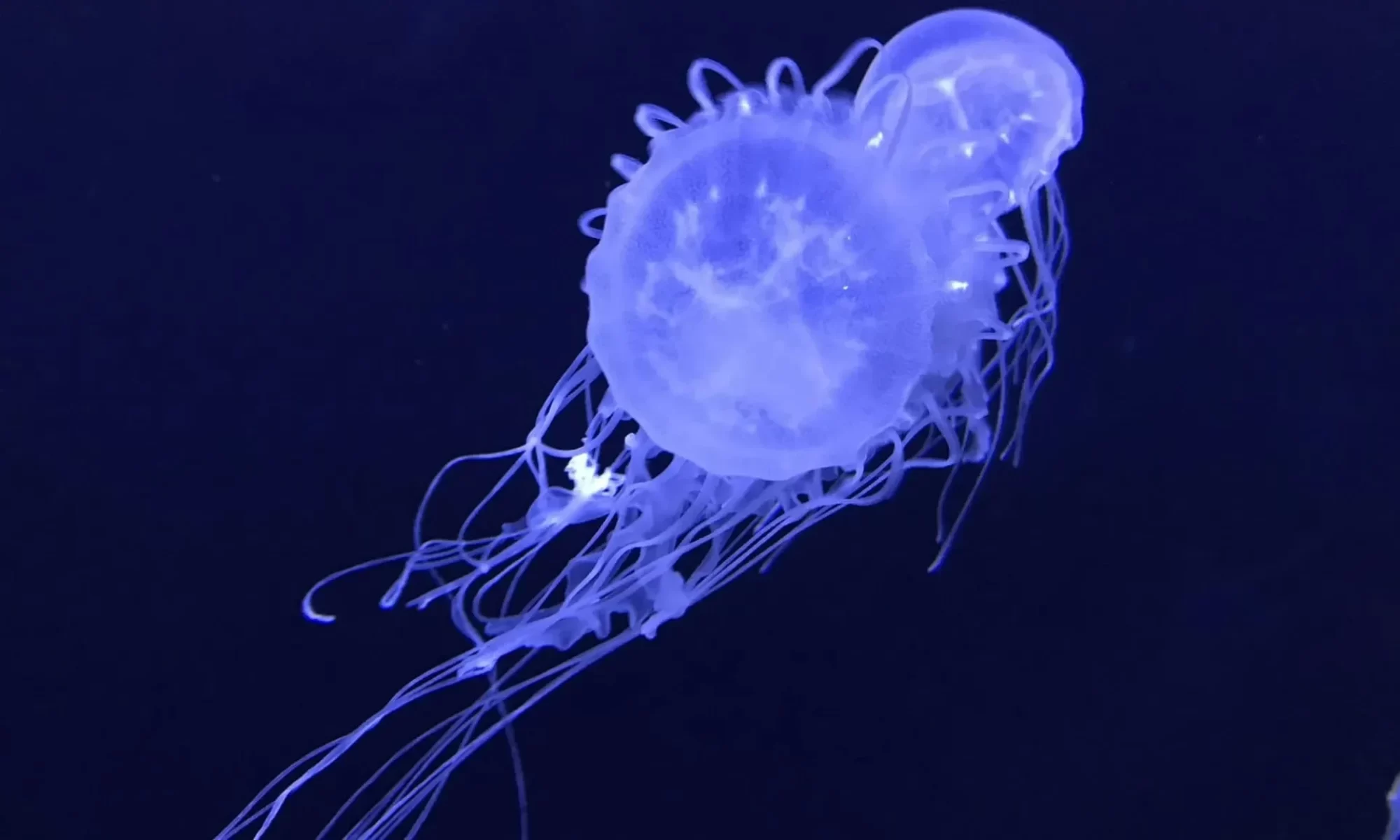
A new species of Portuguese man-of-war discoverd for the first time in the tohoku region – Named “Mikazuki no Eboshi” after Date Masamune

Mikazuki no Ebochi

2025 | Press Releases and Research Results

Tohoku University just released a press release show casing the most recent lab discovery at Sendai Bay. The before-mentioned “Mikazuki no Eboshi”

The emergence of this species may be related to changes in the marine environment caused by climate change, such as the northward shift of the Kuroshio Current and rising sea temperatures. The northward movement of poisonous species not only changes the ecosystem, but also requires caution when swimming in the sea.

This is the first record of the Portuguese man-of-war genus in the Tohoku region. Furthermore, particle tracking simulations revealed that the northward shift of the Kuroshio Current and rising sea temperatures may be related to the emergence of this species. The observation of the Mikazuki no Eboshi provides important evidence that climate change is affecting the distribution of marine life.

You can find the Scientific paper here:

You can find the full press relese here:

OIST x WPI-AIMEC (Tohoku U & JAMSTEC) Joint Workshop

OISTxAIMEC-Banner

Changing Marine Ecosystems: Biogeography of Habitat Shifts and Adaptation to Oceanographic Variability

Date

Thursday, November 20, 2025 – 09:00 to Friday, November 21, 2025 – 18:00

This event will be the fifth joint workshop between Tohoku University and OIST since 2021. This time, WPI-AIMEC (Tohoku U & JAMSTEC) is co-organizing the event. It will include presentations that provide an overview of the current status and challenges of research on the marine environment and marine ecosystems, to promote the exchange of knowledge among researchers from Tohoku University, JAMSTEC, OIST, as well as University of the Ryukyus, and the University of Hawai’i. A majority of presentations will be given by early career researchers, with ample time for discussion to consider future collaborations and joint funding applications.

Check for more information here:

This Gorgeous but Dangerous Jellyfish Was Just Discovered off Japan’s Coast

scitechdaily
Researchers in Japan Discover New Jellyfish Species Deserving of a Samurai Warrior Name

New, Venomous Portuguese Man-of-War Discovered in Japan’s North: Physalia mikazuki

This new species, named Physalia mikazuki (“crescent helmet man-o-war”) in honor of the samurai lord Date Masamune, marks the northernmost recorded presence of the Physalia genus to date, with specimens collected off the coast of northeastern Japan (Sendai Bay).

A student-led research team at Tohoku University (greatly formed by our lab) has formally identified a previously unknown species of the venomous siphonophore, Physalia —commonly known as the Portuguese man-of-war.

Key Scientific Findings:

  1. New Species Identification: Through detailed morphological examination and genetic analysis, the team confirmed that P. mikazuki is genetically distinct from its tropical relatives, specifically Physalia utriculus, which was previously believed to be the only species of the genus inhabiting Japanese waters.
  2. Climate-Driven Range Extension: The appearance of P. mikazuki in the colder waters of the Tohoku region suggests a significant shift in marine distribution. Ocean surface current simulations confirmed that the northward extension of the Kuroshio Current, combined with unusually high sea-surface temperatures, likely transported the colonies to Sendai Bay.
  3. Ecological Significance: The discovery provides direct evidence that climate-related changes in ocean circulation are actively reshaping the distribution of marine species, highlighting the urgency of coastal observation.

The research not only adds a new species to the world’s taxonomic records but also underscores the immediate impact of climate change on ocean ecosystems, influencing where even dangerous marine life can drift and thrive.

Find the original storye at SciTechDaily.com

Find the sicentific paper here:

Media Spotlight: New Samurai-Named Jellyfish Highlights Climate Change Threat

crescent helmet man-o-war

Our recent research paper, detailing the discovery of a new venomous jellyfish species in Japan, has captured international media attention, with outlets highlighting the fascinating cultural connection of its name and its critical implications for marine science.

The discovery, published in Frontiers in Marine Science, confirms the existence of Physalia mikazuki sp. nov.—a new type of Portuguese Man-of-War found unexpectedly far north in Japan’s Tohoku region.

A Name Worthy of a Warrior

The media coverage, including articles from Tohoku University, Asia Research News, and ScienceDaily, emphasized the unique story behind the new species’ name. The jellyfish was named P. mikazuki (“crescent helmet man-o-war”) as an homage to the legendary samurai warrior and feudal lord of Sendai, Date Masamune, who was famous for the crescent moon (mikazuki) adorning his helmet.

This culturally significant name drew attention to a serious scientific finding: the species’ arrival in the temperate Tohoku region is a direct result of marine ecosystem change.

Climate Change Drives Species North

The research, led by a team including Cheryl Lewis Ames, Chanikarn Yongstar, Kei Chloe Tan, and Ayane Totsu, suggests that warming coastal waters and the northward shift of the Kuroshio Current are pushing tropical species into previously untouched temperate zones. The study used DNA analysis and particle simulation modeling (as highlighted by the coverage) to confirm the species is distinct and to track its probable drift path from warmer waters.

This finding serves as a powerful indicator of how climate change is rapidly altering the global distribution of marine organisms, necessitating increased monitoring to ensure coastal safety and ecological understanding.

Access the original article on our site here:

Access the original selected media coverege here:


The IMS Lab is front page whith Doctor Ames

Front page

Tohoku University released its new site design, with a lighter theme and clear lines. The new design is looking really good, but the biggest news for us is that our lab is featured on the front page.

Under the title, “The Romance of Research: Cheryl Ames,” there is an interview with Dr. Ames with text by Taylor Brin that showcases her motivation and ideals put into practice in the collaborative environment that is our lab.

“The Romance of Research: Cheryl Ames” is a really good read, and we are really proud of being portrayed on the new Tohoku University front page.

You can find the article here

And see the new Tohoku University front page here

For more Lab updates, click here

Tohoku Univ. first candidate for huge Japan gov’t research grants

The national university in the northeastern Japan prefecture of Miyagi is set to be formally selected as early as fiscal 2024 as a recipient of annual financial support for up to 25 years from fiscal 2024, starting with around 10 billion yen ($69 million) in the initial year.

Under the new Universities for International Research Excellence program, the grants will be paid out of profits generated from a 10 trillion yen fund.

Tohoku University has been rated highly for its large number of research paper citations, and measures to strengthen its research capabilities and reform its management, the ministry said.

Read the full report from Kyodo News here:

Creating Sustainable Coastal Ecosystems and Fisheries in Northeast Japan

Our team at Tohoku University, led by Associate Professor Alyne Delaney, just launched SEAQUEST – a vital research project tackling the complex challenges facing fisheries in Japan’s Tohoku region since the 2011 earthquake.

We’re blending cutting-edge science, like eDNA and AI for species distribution modeling, with traditional socio-ecological concepts like satoumi and umigyo. This holistic approach helps us understand why some fisheries have declined while others increased, especially with changing ocean conditions and parasitic outbreaks.

SEAQUEST emphasizes community-based citizen science, collecting crucial data from simple water samples. We’re working closely with diverse local and international stakeholders, including fishing communities (even women fishers!), tourism, and industry partners.

Our goal? To combine local ecological knowledge with scientific methods to foster true social and environmental sustainability. Co-Principal Investigators Professor Cheryl Ames and Associate Professor Toyonobu Fujii are key to this interdisciplinary effort.

National Science Foundation Funds Tohoku University-led Seafood Traceability Network

With octopus, squid, and cuttlefish catches soaring but misidentification and inaccurate reporting raising overfishing fears, our international, multidisciplinary team is stepping in. Led by Tohoku University’s own Cheryl Ames (Co-Principal Investigator and Smithsonian Research Collaborator) and Demian Willette from Loyola Marymount University, our 15-member team spans 7 countries and diverse fields, including fisheries management, marine biology, and AI. Associate Professor Alyne Delaney (Tohoku University) is also on board!

Funded by the National Science Foundation, we’re building an application to track and identify octopus from ocean to table. This project uniquely combines traditional methods with cutting-edge tech: genomics, molecular metabarcoding, eDNA, and AI. Fishers in Mexico, California, and Alaska will be key citizen scientists, using eDNA kits to help us map octopus distribution and seasonality.

“Reliable knowledge will point us to where edible octopuses are found, and policymakers can use this information to make octopus fishing sustainable,” says Ames. We’re confident this network will pave the way for ecosystem-based fisheries and contribute to a thriving blue economy.